
Sale setup help
How Transferring Unsold Items to Your Next Sale Works
Transferable sales let a consignor carry unsold items into a later sale using the same tags, with no re-entry or reprinting. Here is how it works, what locks in at setup, and how tagger fees are handled.
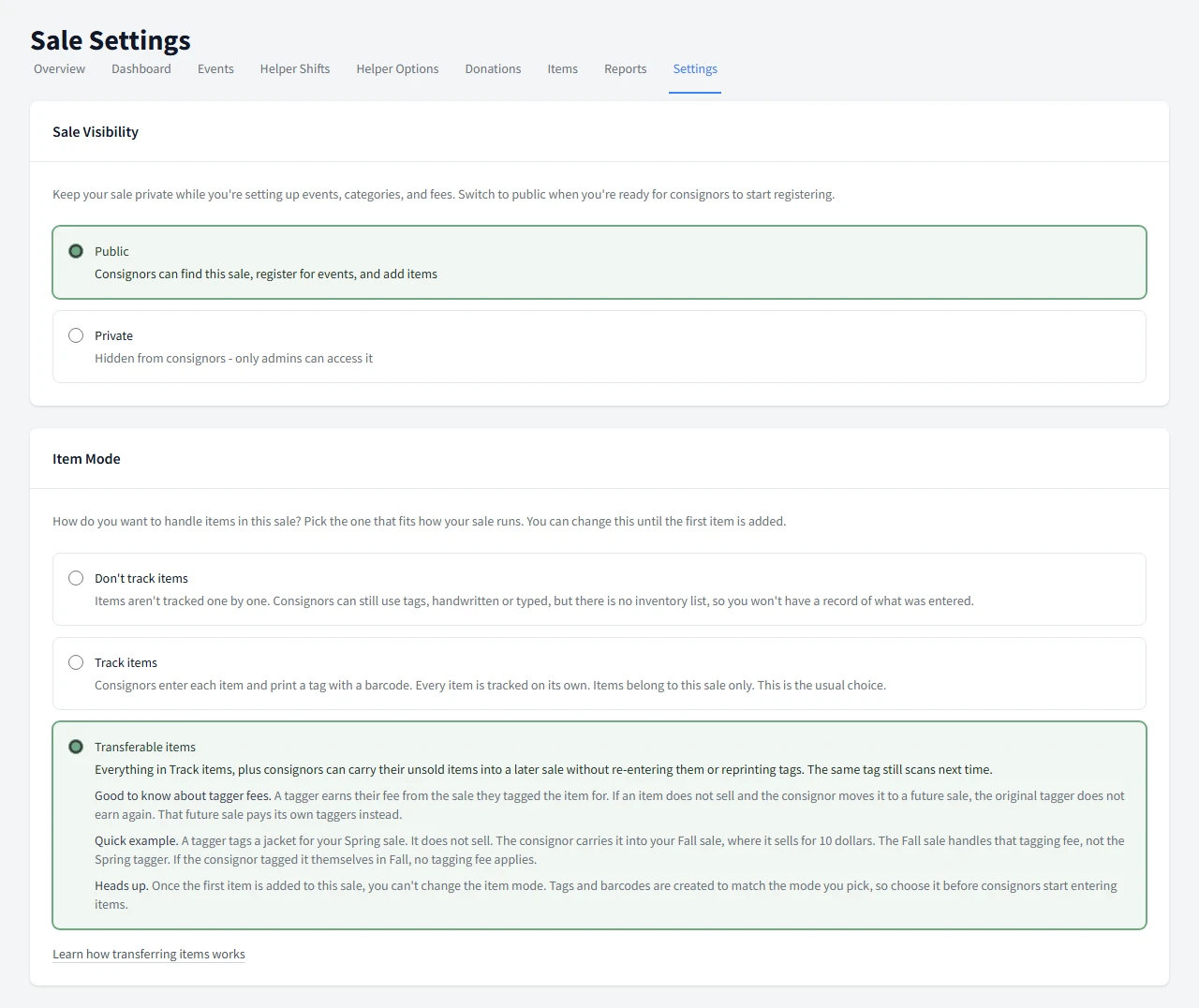
Transferable sales let a consignor carry their unsold items into a later sale without re-entering them or reprinting tags. The same tag stays on the item and scans again in the next sale. You choose this when you set up a sale, and it changes nothing about how shopping and checkout feel on sale day.
What a transferable sale is
Consignment Helper gives a sale three ways to handle items:
- Don't track items. Items aren't tracked one by one. Consignors can still use tags, handwritten or typed, but there is no inventory list, so you won't have a record of what was entered.
- Track items. Consignors enter each item and print a tag with a barcode. Every item is tracked on its own. Those items belong to that one sale.
- Transferable items. Everything in Track items, plus a consignor's unsold items can carry forward into a later sale using the same tags.
Transferable is for organizers who run more than one sale season after season, and who want to save their consignors the work of rebuilding items that simply did not sell the first time.
How a consignor carries items forward
The best part is that there is almost nothing to do. Because the item and its tag already exist, they move to the next sale as they are.
- The consignor enters and tags items in your transferable sale, just like a normal tracked sale.
- The sale runs. Some items sell, some do not.
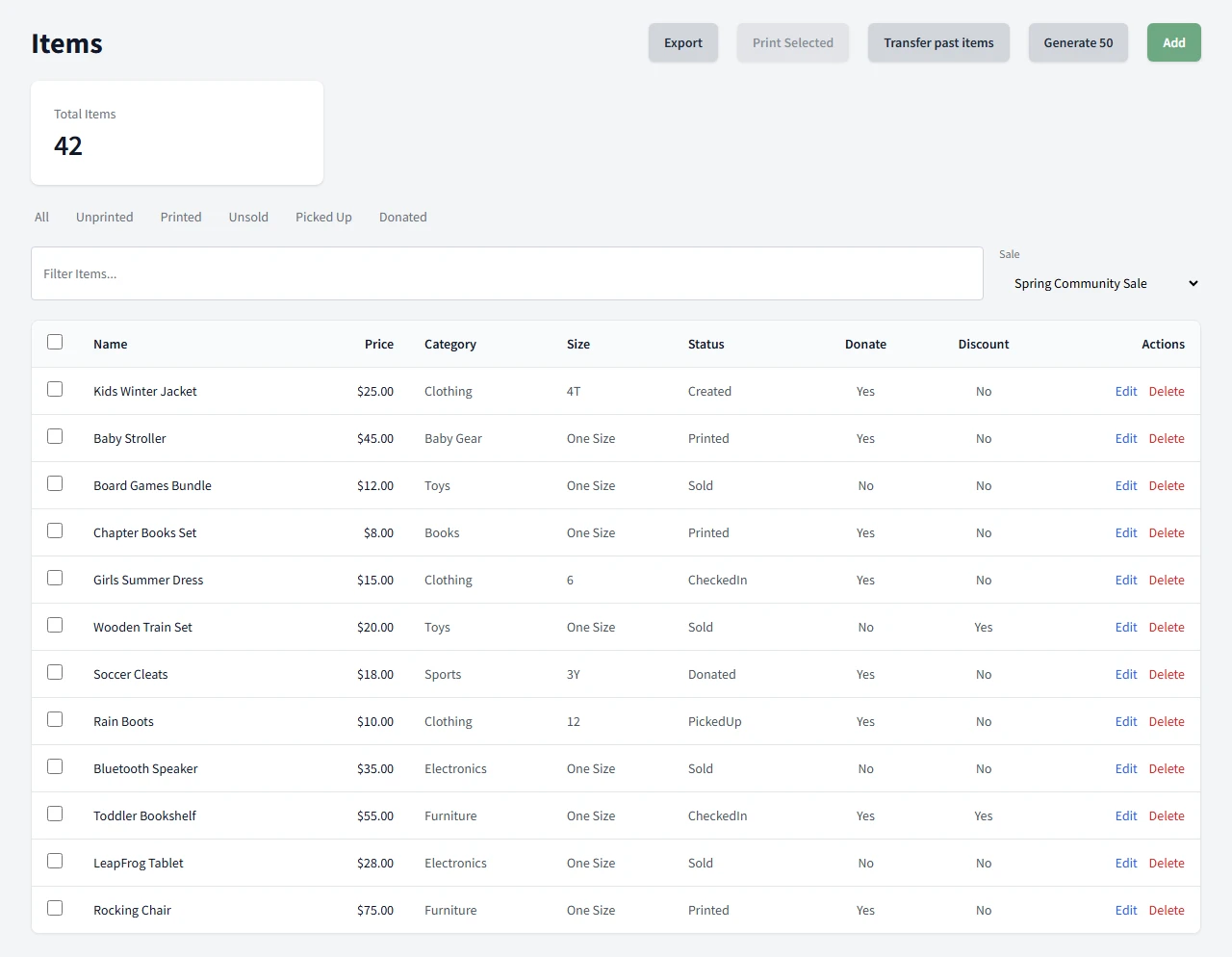
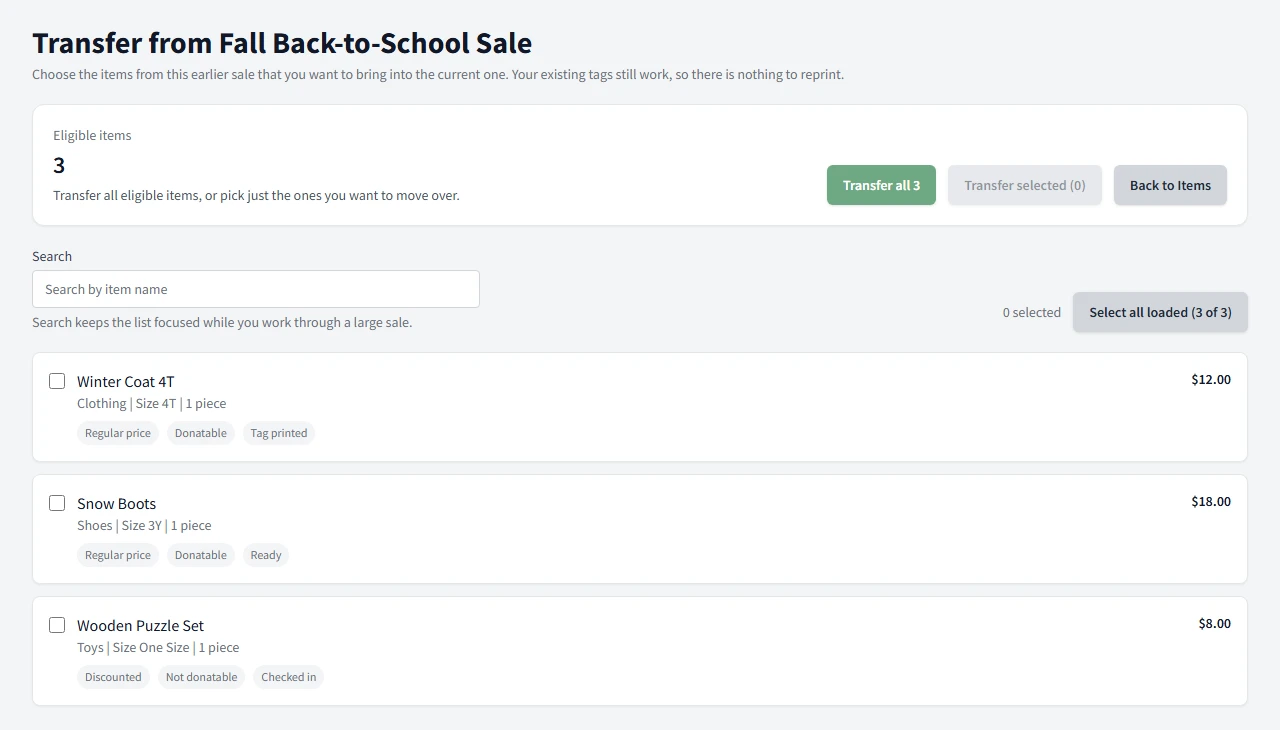
- For the items that did not sell, the consignor chooses to bring them into a later transferable sale.
- Those items appear in the new sale with their details intact, and the original tag still scans at checkout.
No re-entry. No reprinting. The same physical tag on the item works in the new sale. Consignors can still tweak details, like dropping a price, up until they check the item in at drop-off for the new sale.
What organizers need to know before choosing
Two things are worth understanding up front, because one of them locks in.
The item mode is permanent once the first item is added
You can compare and change the item mode freely while you are setting the sale up. But the moment the first item is added to the sale, the mode locks and stays that way for the whole sale. This is not a setting we hide from you later. It genuinely cannot change, because every tag and barcode is built to match the mode you picked. Switching mid-sale would break the tags already printed.
So pick the mode before consignors start entering items. If a sale has already started in another mode and you decide you want transferable, the way to get there is to run your next sale as transferable.
Untracked sales cannot transfer
Transferable builds on item tracking. There has to be a tagged, tracked item for anything to carry forward. A sale that does not track items has no item list at all, so there is nothing to transfer and the option is not offered. If you want items to carry forward, the sale needs to track items.
How tagger fees work when an item transfers
This is the part most worth reading closely, because it is easy to assume the wrong thing.
In many sales, a volunteer tagger can tag items on behalf of a consignor and earns a small tagging fee when those items sell. The rule is simple to state:
A tagger earns their fee from the sale they tagged the item for.
Here is what that means when an item does not sell and moves on. If the item is unsold and the consignor carries it into a future sale, and it sells there, the tagger who originally tagged it does not earn again. That future sale pays its own taggers instead, or nobody, if the consignor tagged the item themselves in the new sale.
A quick example
Say a tagger tags a jacket for your Spring sale. The jacket does not sell.
- The consignor carries the jacket into your Fall sale.
- In Fall, the jacket sells for 10 dollars.
- The Fall sale handles the tagging fee for that sale, not the Spring tagger.
- If the consignor tagged the jacket themselves in Fall, no tagging fee applies at all.
Why it works this way
A tagging fee goes to the person who did the work of tagging an item for a sale. Often that is a volunteer tagging on behalf of a consignor who cannot do it themselves, which takes the work off the consignor and the organizer and helps the whole sale run. Because it recognizes who tagged the item for the sale where it sells, tying it to that sale keeps things fair and easy to follow. One item never pays two taggers for the same work, and every sale's tagging fees go to the people who did the tagging for that sale. It is worth mentioning this to your taggers so nobody is surprised later.
Where to go next
If you are still deciding how your sale should handle items, Categories and Sizes covers what consignors need in place to add items in the first place.
Need the full help set? Return to Setting Up Your Sale.
Common Questions
Can I switch a sale to transferable after it starts?
No. The item mode locks as soon as the first item is added to the sale, because every tag and barcode is built to match the mode. Pick transferable during setup, before consignors start entering items. If a sale has already started in another mode, you would run your next sale as transferable instead.
Does the consignor have to reprint tags to carry items forward?
No. That is the whole point of a transferable sale. The same physical tag stays on the item and scans again in the next sale, so there is nothing to re-enter and nothing to reprint.
Can I use transferable items if I don't track items?
No. Transferable needs item tracking, because there has to be a tagged, tracked item to carry forward. If a sale doesn't track items, there is nothing to transfer, so the option isn't available.
If a tagger tagged an item that later sells in a different sale, do they get paid twice?
No. A tagger earns their fee from the sale they tagged the item for. If the item is unsold and moves to a future sale, the original tagger does not earn again. That future sale pays its own taggers, or nobody if the consignor tagged the item themselves.
Does the consignor keep their same price and details when an item transfers?
Yes. The item carries forward as it was, so the consignor doesn't rebuild it. They can still update details, like dropping a price, up until they check the item in at drop-off for the new sale.
I moved a lot of items at once. Why have they not all shown up in the new sale yet?
For a large batch, bringing items over can take a little while. You do not have to wait on the page. You can leave and come back, and refresh to see items as they arrive. A note shows while a transfer is still running, and you will see a confirmation once your items are in the new sale.